
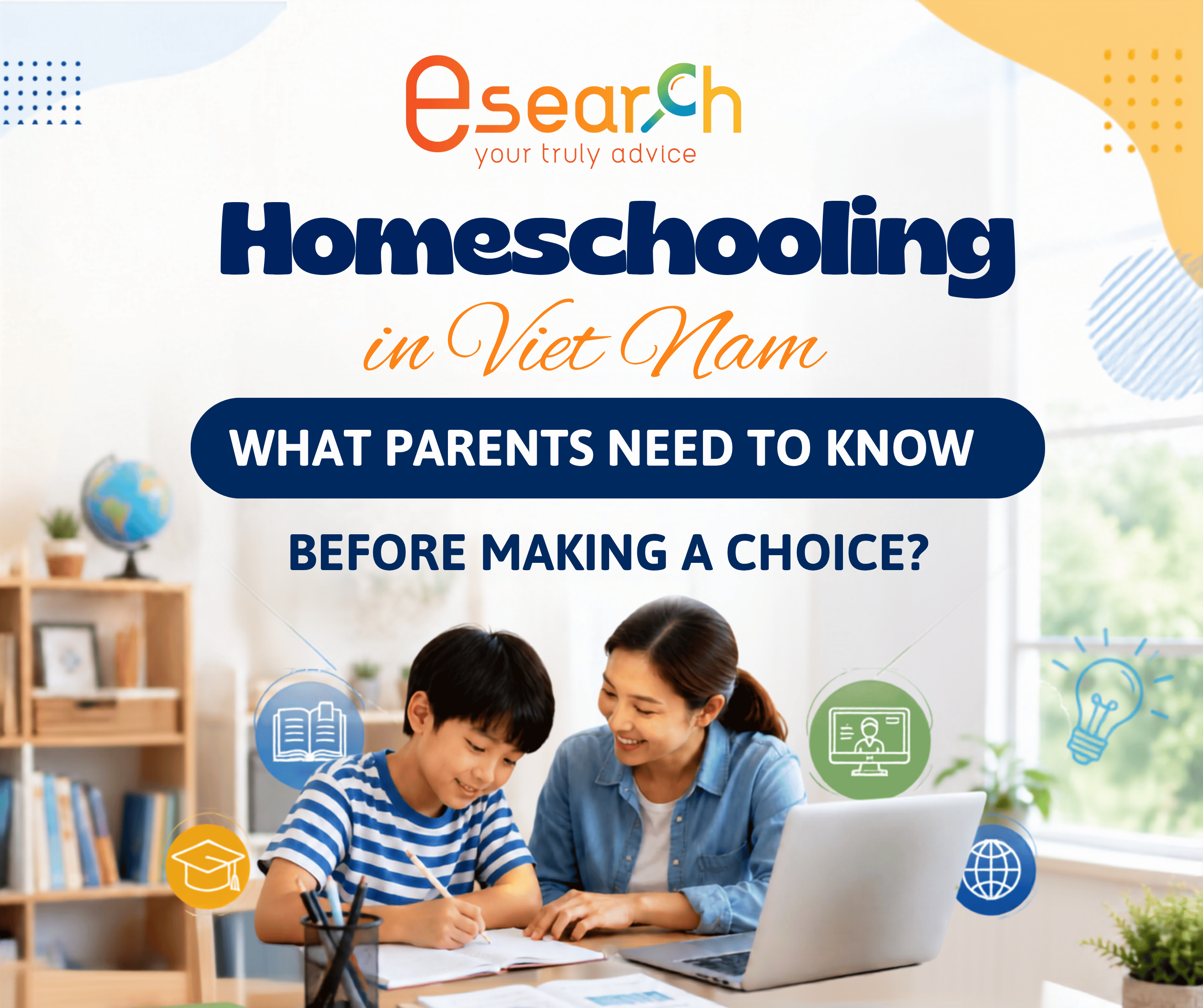
HOMESCHOOLING IN VIETNAM: WHAT PARENTS SHOULD KNOW BEFORE CHOOSING THIS PATH

What is Homeschooling?
Homeschooling is an educational approach in which parents take primary responsibility for their child's learning. Instead of attending a traditional school full-time, students learn through a curriculum selected by their family, often supported by online teachers, tutors, or enrichment programs.
Today, many families adopt hybrid homeschooling, combining home-based academic learning with sports, arts, and community activities to help children develop both academically and socially.
Is Homeschooling Legal in Vietnam?
Vietnamese law does not currently recognize homeschooling as an independent form of general education, but it also does not prohibit parents from organizing or supporting learning at home.
Under the 2019 Law on Education, primary education is compulsory, and parents are responsible for ensuring their children complete compulsory education. Since there is no dedicated legal framework for homeschooling, families should carefully verify the recognition of transcripts, diplomas, and future transfer pathways, especially if the child plans to enter a traditional school, university, or study abroad.
If Your Child Plans to Study Abroad or Attend University, Plan Early
This is one of the most important considerations that families often overlook when exploring homeschooling.
In practice, universities do not make admission decisions based on whether a student was homeschooled or attended a traditional school. Instead, they evaluate applicants based on their academic qualifications, transcripts, and specific admission requirements.
For this reason, if your family chooses homeschooling, it is advisable to define your child's long-term educational goals as early as possible and select a program that aligns with those goals. For example, students aiming to study in the United Kingdom often follow Cambridge International or GCE A Level pathways. Those planning to pursue higher education in the United States may choose accredited programs leading to a U.S. High School Diploma.
Several universities in Vietnam—including RMIT Vietnam, VinUniversity, Fulbright University Vietnam, British University Vietnam (BUV), and the University of Economics Ho Chi Minh City (UEH)—publicly state that they accept certain international qualifications, such as the IB Diploma, GCE A Level, or other recognized overseas secondary school qualifications, subject to each institution's admission policies and annual requirements.
For students pursuing a U.S. High School Diploma through a homeschooling or online education pathway, parents are strongly encouraged to contact their target university before enrolling to confirm whether the diploma and the issuing institution will be recognized for admission. Taking this step early can help avoid unexpected challenges when applying to university or transitioning to higher education in the future.
Is Homeschooling Right for Every Child?
Not necessarily.
Homeschooling may suit children who are independent learners, require flexible schedules, or are pursuing sports, arts, or other specialized interests. However, traditional schools continue to provide valuable opportunities for social interaction, teamwork, and personal development.
Rather than asking whether homeschooling is "better," parents should consider whether it matches their child's learning style, personality, and long-term goals.
What Should Parents Check Before Enrolling?
Before choosing a homeschooling program, parents should confirm:
The school's accreditation and whether it is current.
The institution that officially issues transcripts and diplomas.
The level of teacher support, assessment methods, and academic guidance.
Opportunities for sports, arts, and social development beyond academics.
International Programs Popular Among Vietnamese Families
Some internationally recognized homeschooling programs that Vietnamese families often explore include:
Wolsey Hall Oxford (UK) – Cambridge International & Pearson Edexcel (Primary to A Level).
Crimson Global Academy (New Zealand) – Cambridge, A Level, and Advanced Placement (AP).
Bridgeway Academy (USA) – Cognia-accredited with personalized learning pathways.
Acellus Academy (USA) – Flexible online learning with self-paced study.
Ivy Global School (USA) – K–12 online program that states it is Cognia accredited.
Note: These programs are listed for reference only and should not be considered recommendations or rankings. Parents are encouraged to verify accreditation, diploma-awarding institutions, and recognition before making a decision.
Esearch's Perspective
At Esearch, we believe there is no one-size-fits-all approach to education. Both homeschooling and traditional schooling offer unique advantages, and the best choice depends on each child's needs and the family's long-term goals.
Before making a decision, parents should ask three essential questions:
Which curriculum will my child follow?
Who will issue the diploma?
Will the program support my child's future education pathway?
Making informed decisions today creates stronger opportunities for tomorrow.
Esearch is committed to helping families find the educational pathway that best supports every child's potential.
🌐 Learn more:https://www.esearch.vn/en
References: Vietnam's Law on Education 2019 • Ministry of Education and Training (MOET) • Cognia • Cambridge International • Pearson Edexcel • Wolsey Hall Oxford • Crimson Global Academy • Bridgeway Academy • Acellus Academy • Ivy Global School

HOW MUCH SCREEN TIME IS ENOUGH FOR EACH AGE GROUP?
SCREEN TIME IS NOT BAD, BUT IT NEEDS TO BE USED PROPERLY
In the digital age, children are exposed to screens almost every day: online learning, watching videos, playing games, video-calling relatives, or relaxing after school. Therefore, instead of only asking, “How long should my child be allowed to watch?”, parents should also pay attention to what their child is watching, when they are watching, whether they are watching alone or with adult guidance, and whether screen use is affecting their sleep, physical activity, real-life communication, or not.
From Esearch’s perspective, screen time does not need to be “completely banned”, but it should be managed appropriately according to each age group.

RECOMMENDED SCREEN TIME BY AGE GROUP
For children under 18 months, screen use should be limited as much as possible, except for activities such as video calls with family members. At this stage, children need direct interaction, real voices, touch, play, and opportunities to explore the world around them.
For children aged 18–24 months, if parents allow screen exposure, they should choose short, simple, high-quality content and always watch together with the child. Children should not be left to watch alone for long periods.
For children aged 2–5, screen time should be limited to around a maximum of 1 hour per day. Content should be age-appropriate, moderately paced, and should avoid overly fast, overstimulating videos or violent elements.
For children aged 6–10, parents may allow screen use for both learning and entertainment, but these two purposes should be clearly separated. Entertainment screen time should be around 1–1.5 hours per day, after the child has completed homework, physical activity, and personal routines.
For children aged 11–14, screens begin to connect more closely with learning, friends, games, and social media. Parents should set a limit of around 1.5–2 hours per day for entertainment, while also guiding children to self-regulate, choose safe content, and know when to stop.
For teenagers aged 15–18, screen use should not be managed only by counting hours. Parents need to observe whether screen use is affecting sleep, learning, mental health, physical activity, and real-life relationships. A target of around 2 hours per day for entertainment remains a reasonable goal to maintain balance.
WHEN DOES SCREEN TIME BECOME A PROBLEM?
Screen time needs to be adjusted if children often become irritable when devices are turned off, only eat while watching a phone, stay up late because of games or social media, reduce physical activity, communicate less with family, have difficulty concentrating on schoolwork, or show signs of depending on screens to regulate their emotions.
At that point, the issue is no longer just about “how many minutes” the child watches. It means screens are gradually replacing other important activities in the child’s development.
WHAT SHOULD PARENTS DO?
Families can start with simple rules: no screens during meals, no devices at least 1 hour before bedtime, no phones or tablets in the child’s bedroom, and no using screen time as the only reward.
More importantly, parents need to be role models. It is difficult for children to learn balance if adults frequently use their phones while eating, talking, or playing with them.
FINAL THOUGHTS
Screen time is not the “enemy” of children. When used properly, screens can support learning, connection, and creativity. However, at every age, screens should not replace sleep, physical activity, reading, free play, and real-life interaction.
Therefore, “enough” screen time is not only about the amount of time. It also means safe enough, appropriate enough, and not taking away the essential foundations of a child’s development.
*Esearch is always ready to accompany you in finding the best educational environment for the next generation.
For more details on school programs, facilities, and admissions, please visit:https://esearch.vn/en .
Source: Compiled by Esearch
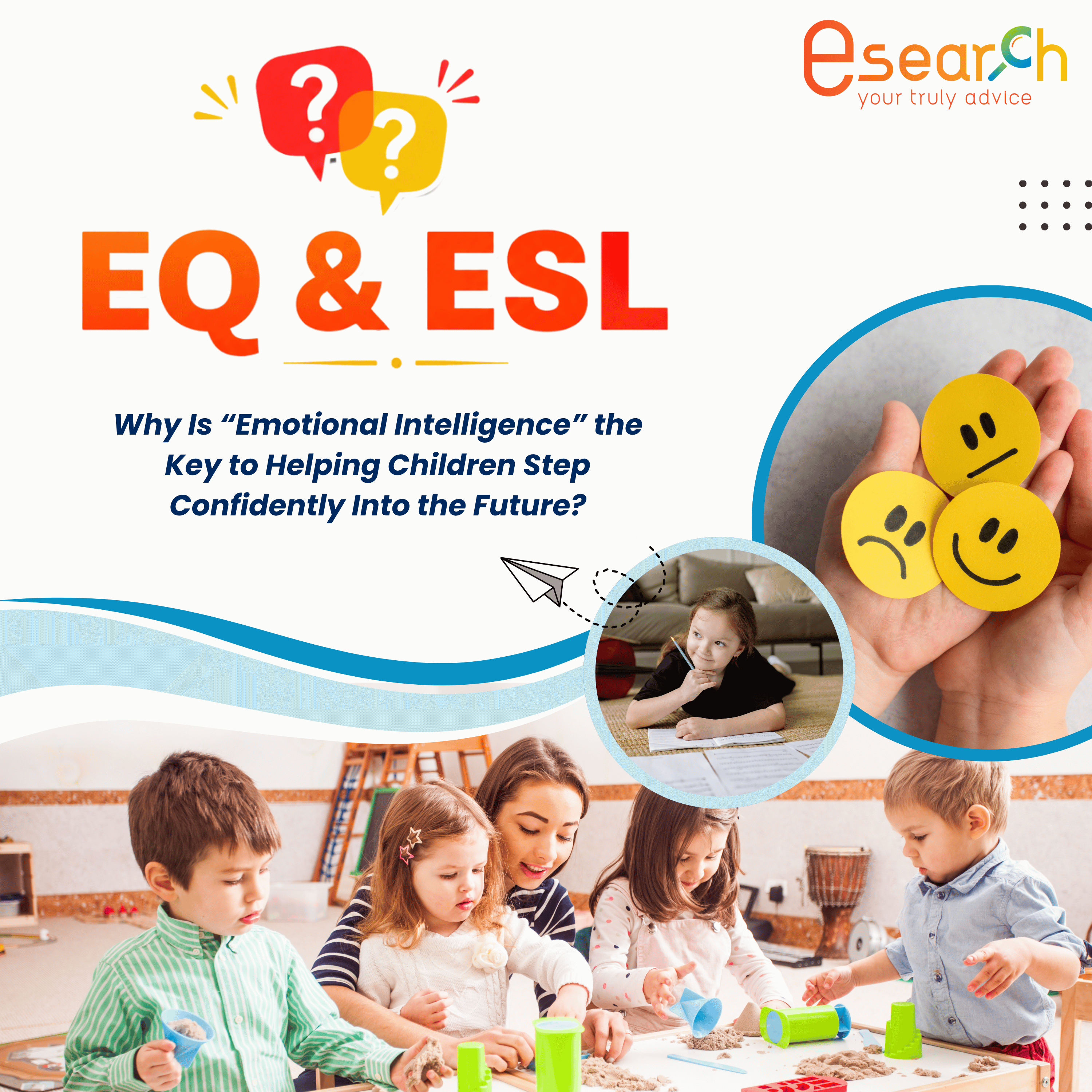
EQ & SEL: WHY IS “EMOTIONAL INTELLIGENCE” THE KEY TO HELPING CHILDREN STEP CONFIDENTLY INTO THE FUTURE?
In our journey of supporting parents in finding the right learning environment for their children, Esearch has noticed a positive shift: parents are no longer asking only, “What curriculum does the school offer?” They are also beginning to prioritize questions such as: “Is my child happy, confident, and able to manage emotions?”
In modern education, knowledge is essential, but social-emotional skills are what help children grow more fully. This is why EQ and SEL are becoming key pillars in children’s holistic development.

WHAT ARE EQ AND SEL?
Many people may confuse these two concepts, but in fact, they complement each other:
EQ — Emotional Quotient: The ability to recognize, understand, and regulate one’s own emotions, while also showing empathy toward others.
SEL — Social and Emotional Learning: The educational process that helps children develop essential skills such as self-awareness, self-management, relationship-building, and responsible decision-making.
According to CASEL — a leading organization in SEL in the United States — social-emotional learning is not a separate subject, but an essential part of human development.
WHY ARE EQ AND SEL IMPORTANT?
1. Helping children learn more effectively
A child may be intelligent, but if they easily lose their temper, fear making mistakes, or give up too quickly, learning can still become difficult. When children know how to manage emotions and become more persistent, they are more likely to learn actively, stay focused, and engage positively.
OECD — the Organisation for Economic Co-operation and Development — has noted that social-emotional skills are linked to academic success, life satisfaction, and reduced anxiety in the classroom.
2. Helping children stay balanced under pressure
Children today face many pressures from academics, social media, comparison, and expectations from those around them. SEL helps children name their emotions, understand what they are going through, and learn healthier ways to respond.
3. Helping children communicate and integrate better
Children need to learn how to listen, share, cooperate, resolve conflicts, and respect differences. These are important skills in the classroom, at home, and in social relationships.
According to CASEL, SEL includes five core competencies: self-awareness, self-management, social awareness, relationship skills, and responsible decision-making.
4. Preparing children for the future
The future does not only need people with knowledge. It needs individuals who can adapt, collaborate, think creatively, and take responsibility for their choices. SEL helps learners develop the knowledge, skills, attitudes, and values needed to create positive change.
WHERE CAN PARENTS BEGIN?
Parents can nurture EQ and SEL through everyday situations: helping children name their emotions, listening instead of judging too quickly, teaching them to say sorry and thank you, encouraging them to share their thoughts, and working with them to solve problems.
Small but consistent actions can gradually help children develop self-awareness, emotional regulation, and more positive behavior.
ESEARCH’S PERSPECTIVE
From Esearch’s perspective, a good educational environment does not only teach knowledge. It also helps children develop emotionally, intellectually, personally, and socially.
When choosing a school for their child, parents should also observe how the school supports children’s emotional development, communication, collaboration, and integration — alongside curriculum, tuition fees, and facilities.
CONCLUSION
EQ and SEL are not “extra” parts of education. They are the foundation that helps children learn better, live more balanced lives, and grow with greater confidence.
At Esearch, we believe a good educational choice should not only answer the question: “What will my child learn?” It should also answer: “What kind of person will my child become?”
*Esearch is always ready to accompany you in finding the best educational environment for the next generation.
For more details on school programs, facilities, and admissions, please visit:https://esearch.vn/en .
Source: Compiled by Esearch.
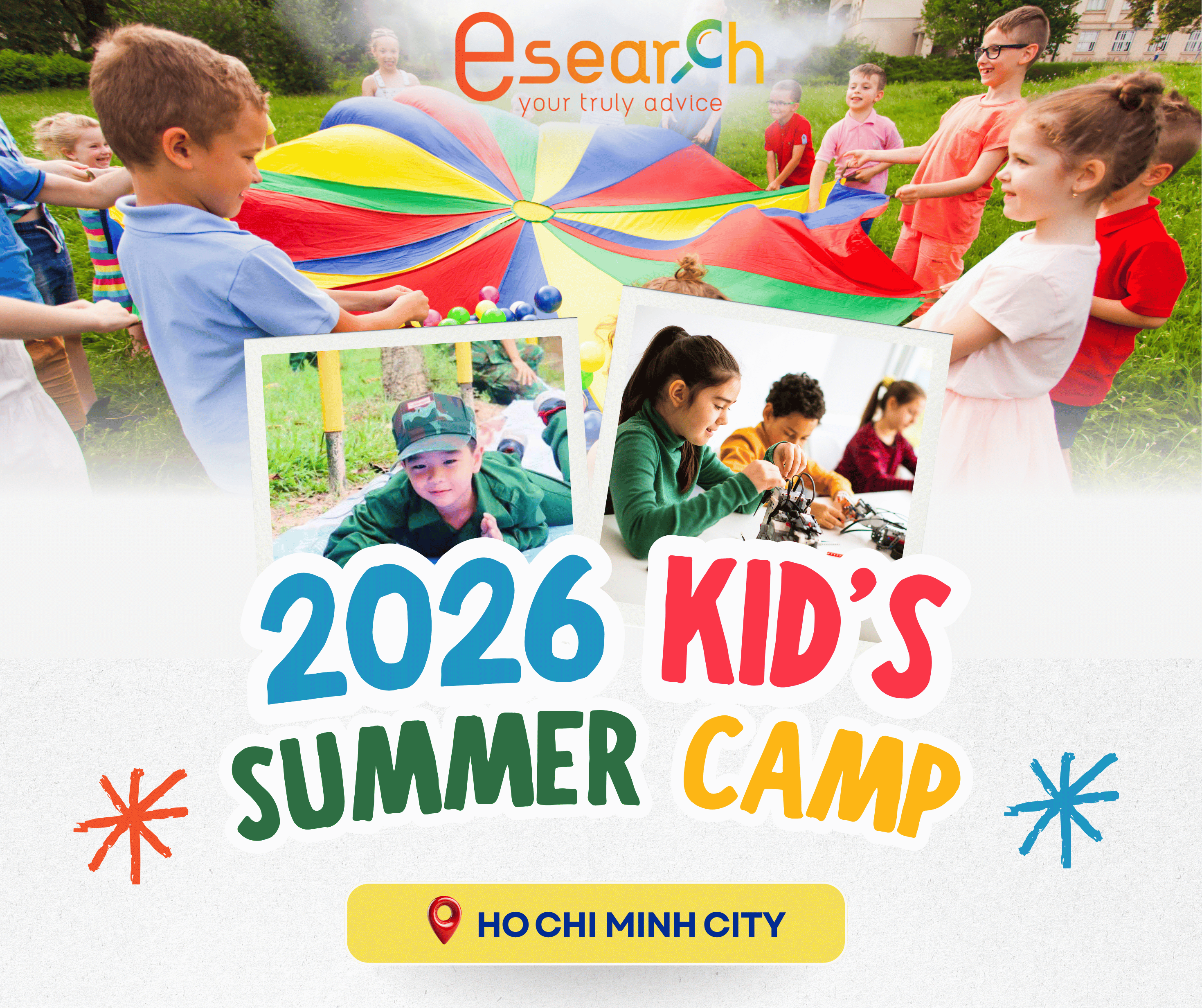
WHERE SHOULD YOUR CHILD’S SUMMER 2026 BEGIN? SUGGESTED SUMMER CAMPS IN HO CHI MINH CITY
Summer is not only a time for children to rest, but also an opportunity for them to explore new experiences: communicate more, stay active, become more independent, and discover their own potential.
In the Ho Chi Minh City – Binh Duong – Vung Tau area, parents can consider different types of summer camps, such as English, technology, life skills, military-style training, and nature survival camps. Each type serves a different developmental goal, so Esearch suggests that parents choose a program based on their child’s age, personality, and actual needs.

1. ENGLISH & INTERNATIONAL INTEGRATION SUMMER CAMP
Suitable for children who need to improve their listening and speaking reflexes, build communication confidence, and become familiar with an English-learning environment.
Featured program: ILA Summer 2026
Organizer: ILA Vietnam / ILA English Center
Age group: 2.5–16 years old
Duration: 7 weeks
Format: Day camp
Program highlights: International-standard English learning combined with experiential activities, skills-based projects, green farm experiences, exploration trips, and summer festival activities. The program is divided into age groups: 2.5–8, 8–11, and 11–16 years old.
Summer camp website:https://summer.ila.edu.vn/
Fanpage:https://www.facebook.com/ilavn
Address: ILA Head Office – The Crest Residence, Metropole Thu Thiem Urban Area, 15 Tran Bach Dang Street, An Khanh Ward, Ho Chi Minh City.
Contact: 1900 6965
2. TECHNOLOGY – AI – ROBOTICS – CODING SUMMER CAMP
Suitable for children who are interested in computers, robots, AI, coding, or need to turn screen time into guided creative learning activities.
Featured program: TEKY Summer Camp 2026
Organizer: TEKY Academy of Technology and Creativity for Kids
Age group: 7–15 years old
Duration: Depending on each camp. For example, the “Introduction to AI” camp runs from June 1 to June 12, 2026, with a total of 40 hours.
Format: Day camp
Program highlights: AI, Robotics, algorithmic thinking, digital products, project-based learning, teamwork, and product presentations.
Summer camp website:https://traihecongnghe.teky.vn/
Fanpage:https://www.facebook.com/TekyAcademy
Address: Southern Office – 152 Dien Bien Phu Street, Ward 25, Binh Thanh District, Ho Chi Minh City.
Contact: 1900 3168; support@teky.edu.vn

3. LIFE SKILLS – ACADEMIC – DAY CAMP
Suitable for children who need a structured summer routine that balances learning and play while developing communication, teamwork, and self-care skills.
Featured program: Sylvan Learning – Summer Fantasy 2026
Organizer: Sylvan Learning Vietnam / New Horizon Education Joint Stock Company
Age group: 6–10 years old
Duration: 9 weeks; includes English communication classes 5 sessions per week
Format: Day camp
Program highlights: English, Math, STEM, life skills, outdoor activities, field trips, a 2-day-1-night camping experience, and basic financial thinking through the Sylvan Dollars model.
Website:https://sylvanlearning.edu.vn
Fanpage:https://www.facebook.com/sylvanlearningvietnam
Company address: 5th Floor, Khanh Minh Building, 55 Suong Nguyet Anh Street, Ben Thanh Ward, Ho Chi Minh City.
Contact: 1900 6747
4. MILITARY-STYLE CAMP – DISCIPLINE – INDEPENDENCE
Suitable for children who need to build discipline, physical strength, teamwork, independence, and responsibility in a group living environment.
Note: The military-style camp is only open to students of Vietnamese nationality.
5. NATURE – SURVIVAL SUMMER CAMP
Suitable for children who need to reduce screen time, spend more time outdoors, become more confident, and connect with nature.
Featured program: Alpha Summer Camp 2026
Organizer: Alpha Camp Academy
Age group: 7–16 years old
Duration: Depending on each journey. For example, the Cat Tien National Park program is announced as a 6-day-5-night journey.
Format: Residential / overnight camp
Program highlights: Experiential learning, SEL, Mindfulness, survival skills, first aid, water safety, nature exploration, physical training, camping skills, hiking, cycling, SUP paddling, and cultural connection with local communities.
Website:https://www.alphacamps.edu.vn
Fanpage:https://www.facebook.com/alphacampacademy
Address: 2nd Floor, 456 Xo Viet Nghe Tinh Street, Thanh My Tay Ward, Ho Chi Minh City.
Contact: 0369 564 865; xinchao@alphacamps.edu.vn
ESEARCH’S SUGGESTIONS FOR PARENTS
If your child needs to improve their English communication reflexes, parents may consider ILA Summer 2026. If your child is interested in AI, robotics, and coding, TEKY may be a suitable choice. If you are looking for a day camp that balances academics and life skills, Sylvan Learning is worth considering. For children who need to develop discipline, physical strength, and independence, the program “Tiep Buoc Hanh Quan – Em Tap Lam Nguoi Chien Si 2026” may be a suitable option. If your child loves nature and outdoor activities, Alpha Summer Camp is a program group worth exploring.
Beyond the program content, Esearch recommends that parents prioritize reputable organizations with experience in running summer camps, clear legal information, transparent contact details, well-trained staff, and specific safety and medical protocols. For camps involving travel, overnight stays, or outdoor activities, parents should carefully check the daily schedule, adult-to-child ratio, emergency response plan, insurance, and refund/cancellation policy before registering.
CONCLUSION
There is no single “best” summer camp for every child. What matters most is understanding what your child needs this summer: more confidence, more independence, more physical activity, or simply new experiences.
Esearch encourages parents to view summer camp as part of a child’s development journey, not merely a place for children to stay during the summer. Before making a decision, choose a program that suits your child and an organizer trustworthy enough for parents to feel secure throughout the summer.
*Esearch is always ready to accompany you in finding the best educational environment for the next generation.
For more details on school programs, facilities, and admissions, please visit:https://esearch.vn/en .
Source: Compiled by Esearch.
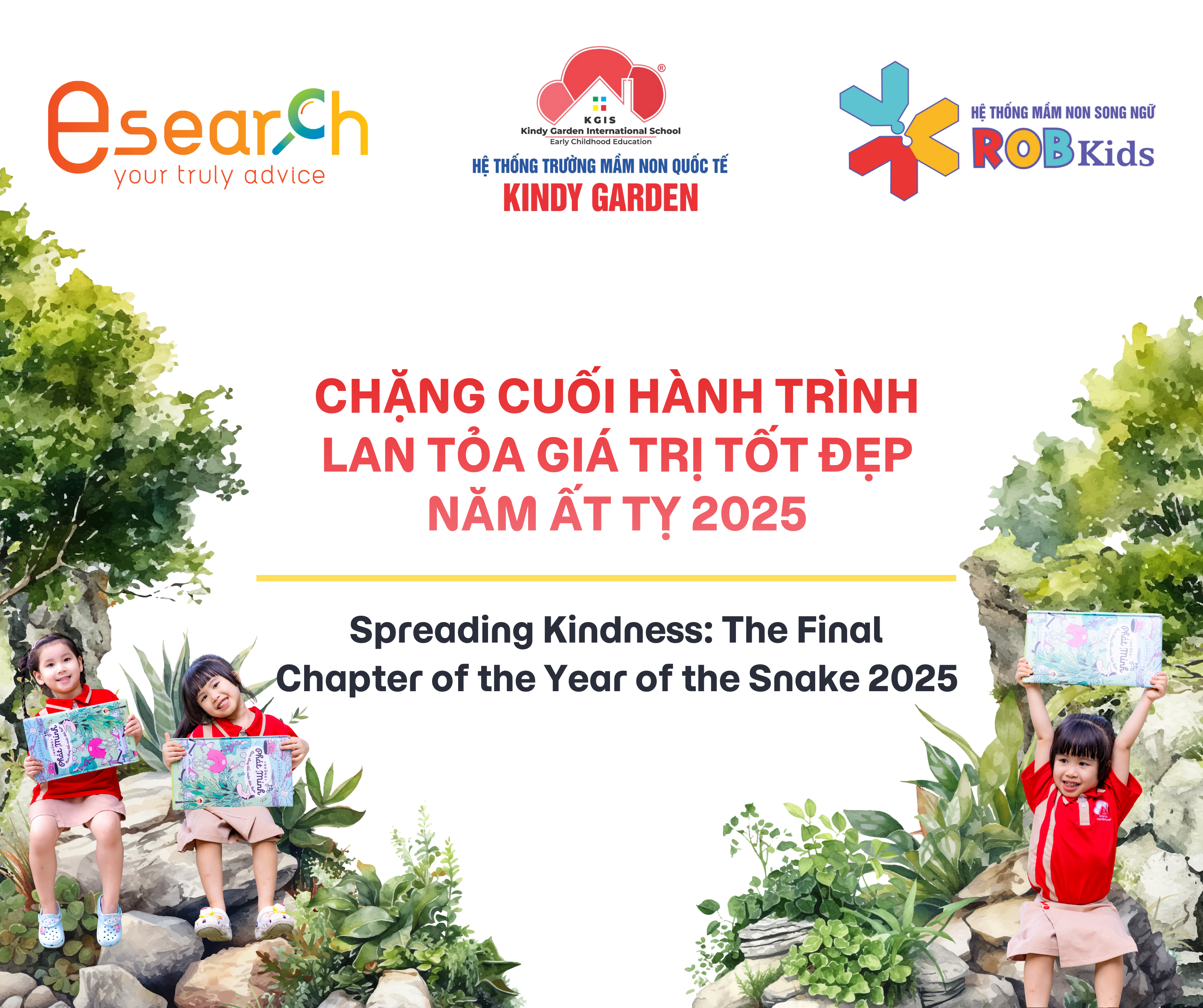
SPREADING KINDNESS: THE FINAL CHAPTER OF THE YEAR OF THE SNAKE 2025

Internal Training Session - January 31, 2026: A Collaboration between Esearch and KGIS International & ROB Kids Bilingual Kindergarten Systems
Meaningful Visits to Schools
Esearch’s "Journey to Spread Positive Values" series has officially concluded for the Year of the Snake, with a meaningful final stop featuring over 200 staff members from Kindy Garden International School and ROB Kids Bilingual Kindergarten systems. This last leg marked more than just the end of the year; it was a space where messages of kindness were shared sincerely and profoundly. For Esearch, each visit is not merely about transferring professional knowledge or skills—it is about the precious moments spent with teachers and school staff to cultivate positive values in education.
Authentic Feedback from Survey Data
After every training session, the Esearch team carefully analyzes feedback from participants. The comments in our surveys are more than just ratings; they are honest reflections and, at times, the passionate concerns of the staff. This data clearly shows a positive shift in mindset. Instead of viewing their work as a set of mechanical processes, many employees shared that they have rediscovered the meaning of serving students and parents, placing kindness as a core principle in every daily interaction.
Empathy – The Bridge to Collective Unity
The most striking result from the surveys was the practicality of the training content. Real-world workplace scenarios and communication skills based on sincerity resonated deeply with the participants. Notably, these sessions effectively strengthened internal bonds. Many staff members expressed their emotions, noting that for the first time, they truly understood the roles and pressures faced by other departments. This empathy has helped the collective become more united, moving together toward common goals for the new year.
The Ultimate Goal: For Children to Grow in Love
Esearch pursues the theme 'Spreading Positive Values' rooted in a core belief: an educational environment only reaches true quality when those within it feel happy and inspired. Beyond just the admissions team or teachers, every individual—from leadership to office staff, security, and logistics—plays a vital role in building trust with parents. Ultimately, our shared goal is to create the best possible conditions for children to grow up surrounded by love. A happy and dedicated team is the solid foundation for nurturing future generations.
Concluding the Year of the Snake, Embarking on New Journeys
The journey of the Year of the Snake concludes, but it is not an end; it is a beginning for sustainable change. The positive feedback from this final leg is the most meaningful gift for Esearch heading into the New Year. We sincerely thank the schools and our colleagues for accompanying us in writing these beautiful chapters of the past year. We look forward to seeing you again with more smiles and even greater values on our upcoming journey, alongside brilliant successes in the year ahead.
*Esearch is always ready to accompany you in finding the best educational environment for the next generation.
For more details on school programs, facilities, and admissions, please visit:https://esearch.vn/en .
Source: Esearch Team
[ESEARCH INSIGHT] PARENTING FROM 0–12: RIGHT TIMING, RIGHT FOCUS
“Learn early to get ahead” or “Play freely to develop naturally”? - These are questions that have weighed on the minds of thousands of parents- one that Esearch has heard time and again throughout our journey supporting families in school selection.
Many parents hope their children will learn to read and do math early to gain an advantage. On the other hand, many believe that if children are simply allowed to play freely, they will naturally grow into maturity. Yet both perspectives can easily fall into the same common mistake: overlooking the principle of “the right thing at the right time.”
Parenting is like building a house: if the foundation isn’t solid but you rush to add more floors, the house will struggle to withstand storms. So at each age, what is the most important “foundation” that parents should build for their children?

1. AGES 0–3: FROM ATTACHMENT TO INDEPENDENCE
This is the foundational stage, yet also the period of the most intense psychological shifts.
0–18 months (Building trust): What children need most at this time is a sense of safety. Psychologist John Bowlby (1969), through years of research, emphasized that children need an adult as a “secure base.” Only when they feel loved and protected will they have the courage to explore the world.
18–36 months (Asserting the self): According to developmental psychologist Erik Erikson (1950), this is when children begin wanting to separate and do things on their own. Tantrums or the phrase “I can do it myself!” are actually positive signals, showing that autonomy is beginning to take shape.
ESEARCH RECOMMENDATIONS:
Encourage choice: Empower within limits. Instead of imposing, allow children to make decisions within a controlled range. For example: “Do you want to wear the blue shirt or the red shirt?”
Accept imperfection: Be patient with “clumsiness.” Parents can use indirect support rather than doing everything for the child, following the principle: “Child tries first - parents help after.”For example: let your child feed themselves even if it’s messy, or put on shoes even if they’re on the wrong feet.
Emotional coaching: Help children recognize and name emotions rather than suppressing “negative” reactions. For example: when your child cries, hug them and ask, “Are you feeling sad/upset?” instead of yelling “Stop crying!”. This is an early lesson in emotional intelligence (EQ).
2. AGES 3–6: SELF-REGULATION AND THINKING
This is a “golden age” for developing the brain’s Executive Functions- the ability to regulate behavior and thinking, according to neuroscientist Adele Diamond (2013). At the same time, psychologist Lev Vygotsky (1978) also emphasized the essential role of purposeful play in developing abstract thinking.
ESEARCH RECOMMENDATIONS:
Play that guides thinking: Play to learn how to think. Prioritize role-play or goal-based construction activities to stimulate imagination. For example: instead of watching a phone, invite your child to play pretend (doctor, shopkeeper) or give a challenge like “Build a garage that can fit two cars.”
Stimulate critical thinking: Use open-ended questions to encourage analysis. For example: “Why did you choose this way?” “What do you think will happen if…?”
Build patience: Activities that require waiting and turn-taking are excellent for strengthening impulse control. For example: hide-and-seek, rock–paper–scissors, or simply lining up and waiting for a turn.
3. AGES 6–12: PERSEVERANCE AND A GROWTH MINDSET
As children enter primary school, they begin wanting to prove their abilities through tangible outcomes. If they don’t experience the feeling of “I worked hard and I can do it,” they may become insecure. This is a critical time for parents to plant the seeds of a Growth Mindset- a well-known concept by psychologist Carol Dweck- helping children understand that intelligence is not purely inborn, but can be developed through practice and effort.
ESEARCH RECOMMENDATIONS:
Acknowledge effort, not “smartness”: Praise effort rather than intelligence so children don’t become afraid of failure. For example: instead of “You’re so smart,” say “I can see how persistent you were in solving this problem”.
Redefine failure: Teach children that mistakes are a necessary part of learning. For example: if your child gets a low score, review the errors together and make a plan to improve rather than punishing.
Set long-term goals: Encourage children to pursue small projects that require consistency. For example: saving in a piggy bank to buy something they love, or practicing riding a bicycle over a week.
4. THE ESEARCH VIEW: CHOOSING A SCHOOL IS CHOOSING AN ENVIRONMENT THAT “NURTURES” CAPABILITIES
Once parents understand their child’s developmental pathway, school visits should go beyond checking facilities. Esearch suggests parents observe small details that reflect a school’s educational philosophy:
For Preschool (0–6): Observe “HOW CHILDREN ARE EMPOWERED”
When a child cries: Does the teacher try to stop the crying immediately, or do they patiently sit down and help the child name their emotions?
Independence: During meals and nap time, are children encouraged to do age-appropriate tasks, or do adults do everything for them?
For Primary School (6–12): Look for a “CULTURE THAT NORMALIZES MISTAKES”
Assessment approach: Does the school recognize progress (process), or is pressure focused only on end-of-term scores?
The right to be wrong: When a child makes a mistake, do teachers punish or guide the child to analyze and try again?
SEL program: Does the school offer Social and Emotional Learning lessons to equip children with “soft skills”?
These questions help parents identify which schools truly care about children’s mental wellbeing and inner strength.
CONCLUSION
At Esearch, we believe that parenting and finding the right school does not have to be a stressful race. Amid the flood of information, parents can feel more grounded with this core formula:
Ages 0–3: Build Safety & Independence
Ages 3–6: Nurture Self-Regulation & Thinking
Ages 6–12: Strengthen Perseverance & Resilience
When parents understand and respect a child’s natural developmental rhythm, they can let go of the pressure to “force-ripen” their child. A strong inner foundation is the best preparation for children to step confidently into the future.
Esearch hopes this article offers greater clarity and supports parents in making the best educational choices for their children.
*Esearch is always ready to accompany you in finding the best educational environment for the next generation.
For more details on school programs, facilities, and admissions, please visit:https://esearch.vn/en .
Note: This article is compiled by Esearch from foundational child-development research and insights distilled from our work supporting parents in selecting the right learning environment. It is for reference only. Every child develops at their own pace; parents should adjust flexibly based on their child’s unique characteristics.
References: Bowlby, J. (1969). Attachment and loss. Basic Books | Diamond, A. (2013). Executive functions. Annual Review of Psychology, 64, 135–168 | Dweck, C. S. (2006). Mindset: The new psychology of success. Random House | Erikson, E. H. (1950). Childhood and society. W. W. Norton & Company | Vygotsky, L. S. (1978). Mind in society. Harvard University Press | Wood, D., et al. (1976). Journal of Child Psychology and Psychiatry, 17(2), 89–100.
Source: Esearch Insight


